



Indoor plants for homes with pets: complete 2026 guide
For households with pets, a non-toxic plant for cats and dogs is one with no known toxicity to these animals, chosen to add greenery to the home without introducing an accessible toxic species. The Maranta Leuconeura Fascinator is a good starting point; this 2026 guide helps you compare foliage, organize placement, and adapt care.
- Monjungle: choose an identified non-toxic plant for cats and dogs, rather than an assortment with uncertain contents.
- Maranta leuconeura is suitable for lovers of colorful foliage; Haworthia fasciata requires more spaced-out watering.
- Non-toxic does not mean edible: prevent nibbling and keep fertilizers, potting soil, and standing water out of reach.
- For a plant-based Christmas gift, check each species before choosing a plant or an advent calendar.
Why this choice matters in a home with pets
Your cat explores the shelves, your dog grabs a fallen leaf: choosing a plant solely for its beauty is not enough. You must also consider its identity, its placement, and your pet's habits.
A non-toxic plant remains a decorative plant, not pet food. Eating leaves or potting soil can cause digestive problems, even without a plant substance known to be toxic. The pot, treatments, and accessories add their own risks.
For your 2026 selection, therefore, separate two questions: does the plant have known toxicity, and can you place it properly in your home? A poorly placed Maranta remains accessible for nibbling; a stable planter does not make a Philodendron non-toxic.
Monjungle is suitable for cat and dog owners who want to choose their indoor plants one by one. This precise selection allows you to check each species, unlike a choice based solely on a color or decorative category.
How to choose and care for your plants with pets
Identify each plant before finding it a place
Start for free with the labels already present and a list on paper. Write down the name of each plant, then separately check its toxicity for cats and dogs: an attractive commercial name is not sufficient identification.
The ASPCA public database on toxic and non-toxic plants for dogs and cats is a useful reference. Search for the botanical name, that is, the scientific name that distinguishes the plant from other species. A photo app helps guide a search, but does not replace this verification.
If the identity remains uncertain, place the plant in a room inaccessible to animals. Never assume its safety from its resemblance to another.
- Photograph the entire plant and its label.
- Write down its scientific name when it appears on the sheet.
- Check the information for both animals concerned.
- Isolate plants whose identity remains uncertain.
Choose according to your light and availability
First, observe your room throughout the day. A bright window without scorching sun is suitable for Maranta and Calathea; a dark corner does not become suitable simply because the plant is called "indoor".
Maranta leuconeura is suitable for people ready to regularly monitor the moisture of the potting soil. An Haworthia fasciata, a small succulent that stores water in its leaves, is more suitable for those who prefer to let the substrate dry out between waterings.
Calathea White Fusion requires more attention: its variegated foliage, mixing several colors, appreciates indirect light and a stable environment. Choose the plant you can properly care for, not the one that only promises the most beautiful effect.
- Identify direct light and filtered light.
- Rule out placements against a radiator.
- Choose an Haworthia for spaced-out watering.
- Reserve Calathea for people attentive to the potting soil.
Compare specific plants rather than assortments
Create a short selection based on your room and your habits. You can then compare the Monjungle sheets: for a non-toxic plant for cats and dogs, the exact name matters more than a general mention like "easy plant".
The table below distinguishes options suitable for different needs. The toxicity indications concern the plants themselves; they do not guarantee the safety of a treatment applied to the foliage or an accessory added to the pot.
| Option | Ideal for | Light and watering | Difficulty and main limitation |
|---|---|---|---|
| Maranta Leuconeura Fascinator | Colorful foliage in a bright room | Indirect light; slightly moist potting soil, without standing water | Intermediate; does not tolerate prolonged watering oversights well |
| Calathea White Fusion, 7 cm pot | A lover of white and green leaves attentive to care | Indirect light; potting soil moisture to monitor | Demanding; sensitive to scorching sun and dry air |
| Stromanthe Triostar, 7 cm pot | An urban jungle with multicolored foliage | Indirect light; watering before complete drying | Intermediate to demanding; leaves suffer from overly dry conditions |
| My first plant – Haworthia with colorful animal planter | A beginner preferring to water less often | Bright placement; substrate to let dry | Accessible; sensitive to excess water |
A Calathea White Fusion also exists in a 14 cm pot in the provided references. This size does not change its identity or its needs: do not confuse container size with ease of care.
- Compare the precise name, not just the photo.
- Choose light before the color of the foliage.
- Check the pot size for your placement.
- Rule out an assortment whose species are not specified.
These two options illustrate different routines: Maranta requires regular monitoring of the potting soil, while Haworthia appreciates drying out between waterings. Choose according to your daily life, without trying to apply the same rhythm to them.


Place the pots without relying solely on their height
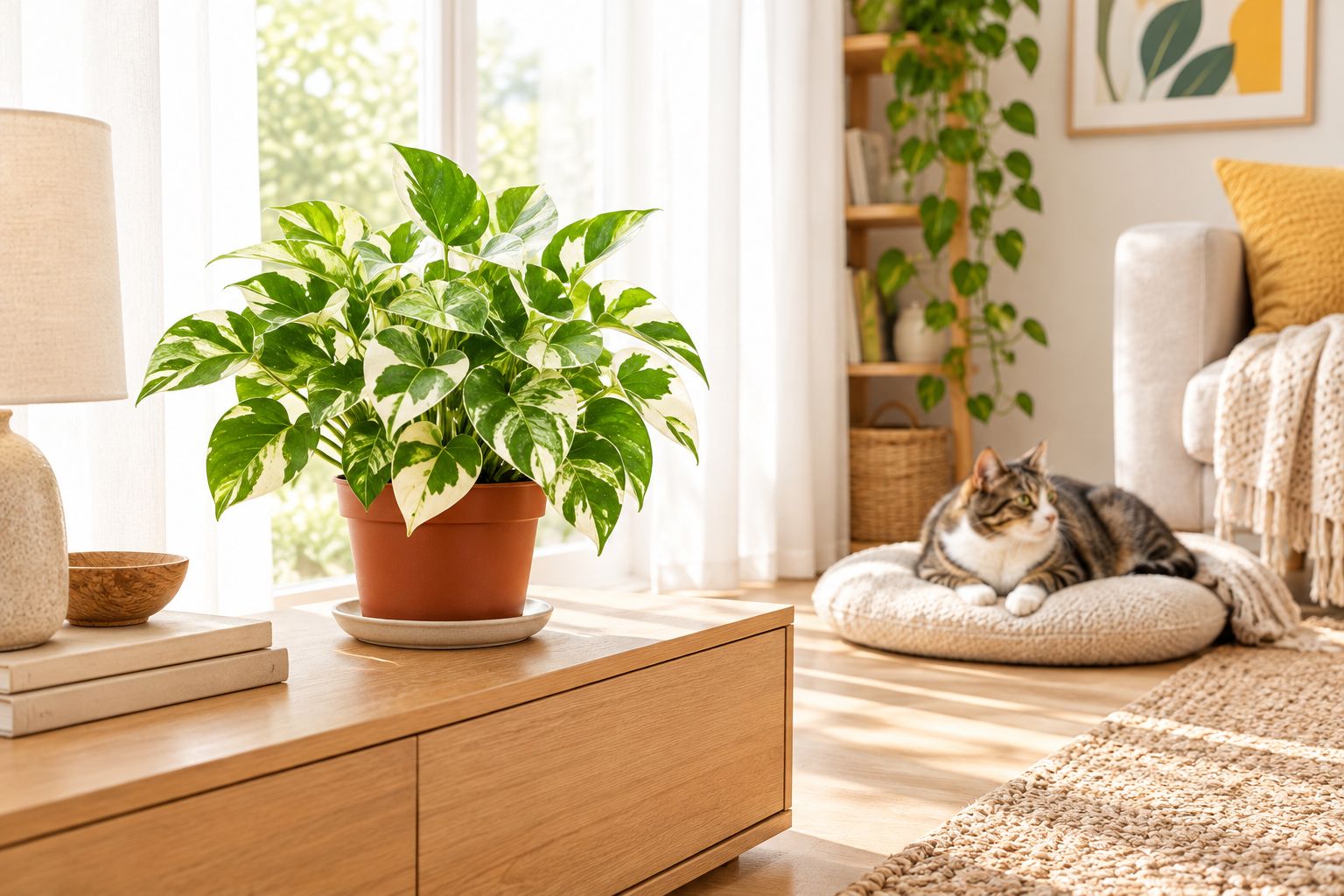
First, look around your furniture with your pet's eyes. A dresser placed against a sofa forms an easy access for a cat; a trailing plant brings the leaves closer to the floor, even when its pot appears far away.
Favor a stable support and keep walkways clear. For a toxic plant already present, a high shelf does not replace a truly inaccessible room. A hanging plant must also remain securely fixed and without accessible stems.
Remove small decorative elements that a pet might swallow. Beads, stones, and ties do not become safe because they surround a non-toxic plant.
- Test the stability of the pot and its support.
- Identify furniture serving as a step stool.
- Move stems away from walkways.
- Remove accessible small accessories.
- Pick up fallen leaves.
A good placement combines light and stability, without forcing your pet to go around the plant to reach its bed. Also keep a saucer easy to remove to empty the water after watering.
Adapt watering and repotting to each plant
Check the potting soil with your finger before taking out the watering can. For a Maranta, wait until the surface begins to dry without letting the entire root ball become dry; for an Haworthia, let the substrate dry out between waterings.
Water in a pot with drainage holes, let the water drain, then empty the saucer or planter. The substrate simply refers to the mixture in which the roots grow. It must match the plant: a succulent does not have the same needs as a Maranta.
Repot when the roots lack space or when the mixture no longer properly fulfills its role, not solely because a plant has just arrived. During the operation, keep animals away and store care products before letting them return.
- Check the potting soil rather than a fixed calendar.
- Use a pot with drainage holes.
- Empty the water after it drains.
- Prepare the repotting out of reach of animals.
- Store fertilizers and tools after use.
Prepare plant gifts and new arrivals
For Christmas 2026, start by asking if the recipient lives with a cat or a dog. A non-toxic plant, chosen for its home, constitutes a more suitable gift than a rare variety selected solely for its appearance.
A plant advent calendar, a monthly box, or a surprise basket requires the same verification for each species. The surprise nature does not allow concluding compatibility with animals. If the composition is not specified, choose instead an identified plant.
At Monjungle, apply this filter to plants as well as cuttings: a small size does not remove the toxicity of a species. Add a simple care sheet to your gift and provide a separate place to observe the new arrival.
- Ask what animals live in the home.
- Check each species of an advent calendar.
- Choose a named plant if the composition remains uncertain.
- Include light and watering advice.
- Observe the new plant before integrating it with the others.
Common mistakes in households with animals
Confusing an easy plant with a non-toxic plant
Pothos, Philodendron, Monstera, Alocasia, and Dieffenbachia are not suitable for a space accessible to animals that bite. These plants contain irritating calcium oxalate crystals. An Alocasia sold in a 6 cm pot is not exempt from this precaution: small format does not mean small risk.
Treating all colorful foliage as equivalent
Maranta and Calathea do not present the same profile as Begonia or Aglaonema. The pink, white, or silver color does not inform about toxicity. Check each name, including for a new variety that resembles a plant already present in your home.
Forgetting what accompanies the plant
Fertilizers, treatments, standing water, and small accessories remain to be monitored even with a non-toxic species. Do not let your pet drink from the planter or root through an open bag of substrate. Read the product instructions and respect their precautions for use.
Waiting for symptoms after a suspected ingestion
If your pet chews a potentially toxic or unknown plant, contact a veterinarian quickly. Keep a photo, the label, and information about the ingestion. Do not make them vomit and do not give any home remedy without veterinary instructions.
FAQ
Which non-toxic plant for cats and dogs to choose to start?
Maranta leuconeura and Haworthia fasciata are two non-toxic options for cats and dogs. Choose the Maranta for indirect light and regular monitoring of the potting soil, or the Haworthia for more spaced-out watering.
Is a Calathea White Fusion toxic to my cat?
Calathea White Fusion is part of the Calathea considered non-toxic for cats and dogs. However, prevent nibbling: the ingestion of plants can cause digestive problems.
Is a Monstera suitable for a home with a dog?
A Monstera should not be left within reach of a dog that chews on plants. It contains irritating calcium oxalate crystals; choose another species for shared spaces.
Can I put all my plants up high to protect my cat?
No, height alone does not guarantee that a cat will stay away from plants. Nearby furniture and trailing stems make them accessible; a toxic plant requires a truly inaccessible space.
What should I do if my dog has eaten an unknown plant?
Contact a veterinarian immediately and keep a photo of the plant as well as its label. Tell them what your dog chewed and when; do not induce vomiting without veterinary instructions.
Is a plant advent calendar suitable for homes with pets?
A plant advent calendar is only suitable after checking each species and the conditions of its placement. For Christmas 2026, do not assume a surprise assortment is non-toxic without a precise list of contents.
Should a Christmas gift plant be repotted immediately?
No, immediate repotting is not always necessary. First check the condition of the roots, drainage, and potting mix, then adapt the care to the species in a space away from pets.
One last tip: also prepare your plant information card
For your urban jungle in 2026, photograph each new plant with its label before throwing away the packaging. Keep this image with its care instructions: you will be able to identify it for repotting, gifting, or calling a veterinarian.
The best choice is not just a non-toxic plant: it is an identified plant, properly placed and suited to your habits. Start with one whose needs you understand, then grow your collection without losing sight of this rule.
To complete your selection
Share


