



How to choose a plant advent calendar?
When choosing a plant advent calendar for 2026, start with the light available in your home, then consider whether you want to grow cuttings or welcome young plants. The right plant gift suits the recipient's daily life, not just the number of surprises. Also check the rooting, the listed varieties, and the opening instructions: these details determine the care required.
- Choose a plant advent calendar based on light, experience, and available space.
- Monjungle is suitable for plant gift lovers who want to choose between cuttings and young plants.
- The 25-cutting package, including 5 rare ones, is suitable for someone who likes to propagate their plants.
- The 15 baby plants and 10 accessories package is suitable for someone who wants a wider variety of discoveries.
- Check the rooting and the specific care for each variety: rare does not mean easy.
How to choose a plant advent calendar?
First, choose the type of plants you want to care for. A cutting is a plant fragment intended to continue growing; a young plant has already begun its development. The word "cutting" does not specify, on its own, whether roots are present.
The two Monjungle calendars below meet different needs. Their stated composition allows you to compare the formats, but it does not replace reading the needs of each variety.
| Calendar | Stated composition | For whom? | Strength | Point of caution |
|---|---|---|---|---|
| Plant Advent Calendar – 25 Plant Cuttings, Including 5 Rare Ones | 25 cuttings, including 5 rare ones | Propagation enthusiasts | A format focused on plants to grow | Check the rooting and plan the necessary space for care |
| Plant Advent Calendar – 15 Baby Plants and 10 Accessories | 15 baby plants and 10 accessories | Lovers of young plants and varied discoveries | A mix of plants and accessories | Check the varieties and the nature of the accessories, without assuming |
None of these compositions automatically means that all the plants are different, that each cutting is rooted, or that all the accessories are for repotting. Only remember what the product page specifies.
Why this choice matters before Christmas
A plant calendar continues to require attention after the holidays. For Christmas 2026, think as much about the location of the plants in January as about the pleasure of discovering the box in December.
A collection of small plants requires monitoring several pots, sometimes with different needs. Giving plants to someone who is often away therefore does not have the same meaning as giving them to someone who already observes their cuttings every morning.
The right guideline is simple: imagine the gift once opened. If you do not know where to place the plants or who will take care of them, settle this question before choosing the format.
The 25-cutting format, including 5 rare ones: for those who love watching them grow
This format is especially suitable for someone who likes to follow the development of roots and new leaves. The 25 cuttings place cultivation at the heart of the gift, with 5 cuttings listed as rare.
Its appeal is the pleasure of growing the plants. Its constraint is just as concrete: you must observe each plant and adapt its placement to its condition, rather than treating all the contents the same way.
Before choosing, check these points:
- Are the cuttings rooted or do they still need to produce roots?
- Are the varieties named, partially announced, or left to surprise?
- Are there instructions explaining how to set up the plants upon receipt?
- Do you have a bright location to welcome the whole set?
The term "rare" here describes the stated composition, not a difficulty of care. A sought-after plant is not necessarily delicate, and a common plant is not necessarily adapted to all rooms.
Choose this format for the pleasure of propagation, not solely for rarity. Without information on the varieties, do not assume either their simplicity or their level of demand.
The 15 baby plants and 10 accessories format: for varied discoveries
This format is suitable for someone who appreciates young plants and a gift combining several types of surprises. It announces 15 baby plants and 10 accessories: it is therefore not a package of 25 plants.
Its appeal is this alternation between plants and accessories. Its limitation lies in the details to check: the word "accessory" does not tell you if it is a decorative element, a tool, or another object.
Do not also consider that a baby plant dispenses with care. A small pot requires careful observation, and the need for water depends notably on the growing medium, the light, and the roots.
For a beginner, look above all for clear explanations and varieties adapted to their home. Fewer plants does not automatically mean less difficulty: their identity matters more than their number.
The two formats presented allow you to choose between an experience focused on cuttings and a composition combining young plants and accessories. Find their details on their respective pages before deciding.


Why the right calendar varies according to your home
For your choice in 2026, the number of plants remains a secondary criterion compared to growing conditions. Here are the factors to examine before choosing a box.
- Light. A place on a shelf away from the window does not receive the same light as a bright windowsill. Identify the actual location, not just the room.
- Rooting. A cutting without roots is not handled like a plant already established in soil. Check its stated condition and follow a method adapted to the plant.
- Varieties. Their needs guide watering, exposure, and the growing medium. Do not infer a common routine from the word "tropical" alone.
- Space. Think about pots and saucers, but also the access necessary to inspect leaves and water without moving everything.
- Your experience. If you are a beginner, favor plants whose needs are clearly explained to you. If you collect, check their compatibility with your conditions instead.
- Your presence. Plan who receives the package, opens the packaging, and monitors the plants during end-of-year travel.
A successful gift does not require transforming your living room into a greenhouse. It must above all find its place in the recipient's habits.
How to prepare for the arrival of the plants?
Prepare the welcome before opening the box. Living things come before the calendar ritual: follow the reception instructions and do not leave a plant enclosed to preserve the surprise.
- Choose the location. Identify a bright area, without contact with a radiator or cold draft. Then adjust the exposure to the received varieties.
- Read the instructions. Identify the plants and the recommendations specific to the box before removing the protections or changing their setup.
- Observe the roots. Distinguish a cutting to be rooted from a plant already rooted. Avoid pulling on the stem to check its hold.
- Adapt the care. Check the humidity of the growing medium and the condition of the leaves. Do not systematically water all the contents upon opening.
This preparation avoids looking for a place for the plants once all the packaging is opened. Also keep something to write their name: a clear identification helps to find the right care tips.
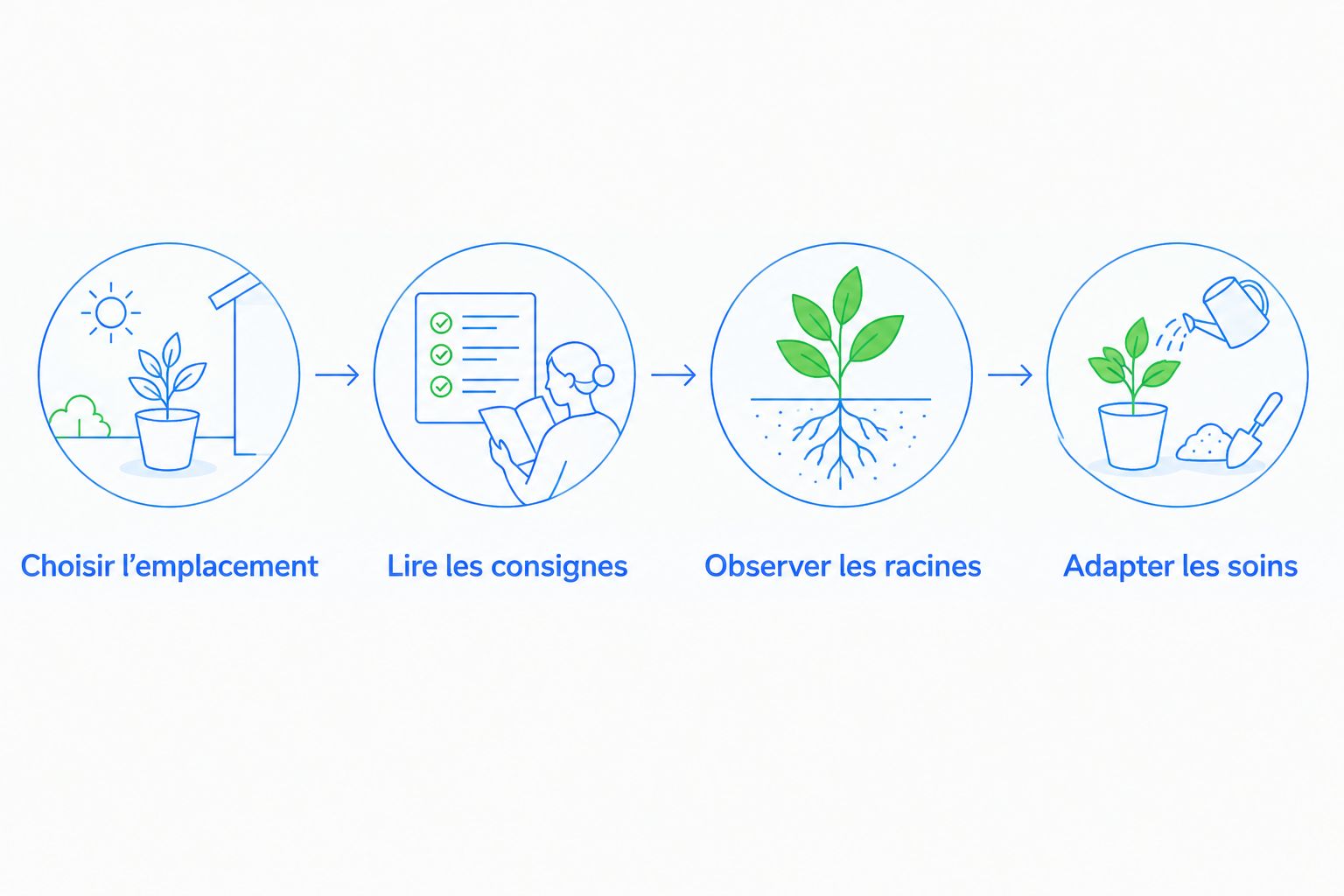
Light, watering, and repotting: the steps to plan
What light to plan for young plants?
Install the plants according to the needs of their variety. Indirect light means light received without sun directly hitting the foliage; a blind can notably attenuate direct exposure.
In December 2026, as every winter, observe the light actually received at the chosen location. A room that seems bright to you does not necessarily offer enough light at the back of a bookshelf.
Do not then move all the plants into direct sunlight to compensate. First look up their needs and adapt their exposure gradually.
How to water without applying the same rule to the whole box?
Water according to the plant and the humidity of its substrate, not according to a fixed date. The substrate is the mixture in which roots grow: potting soil, bark, or other components according to the plant's needs.
Touch the mixture and observe its condition before adding water. For a plant in a perforated pot, let the water drain and empty the saucer; do not let the roots soak by habit.
A cutting installed in water follows a different routine than a young plant in soil. Therefore, keep the instructions specific to each plant rather than creating a single rule for the whole calendar.
Should you repot upon opening?
No, repotting is not a mandatory step upon receipt. First examine the roots, the condition of the mixture, and the container, then intervene if the situation justifies it.
A much larger pot does not automatically help a small plant: the unused mixture by the roots can stay damp longer. Choose a container adapted to the root system and the needs of the species.
Above all, avoid chaining a change of place, repotting, and modification of the cultivation method without reason. Take the time to observe the recovery before multiplying interventions.
Is it a good gift for someone who is starting out?
A plant calendar is suitable for a beginner who wants to learn and has a suitable location. The format is not enough to guarantee ease: check the varieties, their rooting status, and the explanations provided.
If the recipient does not yet have any plants, talk to them discreetly about their desires. Some people like to follow cuttings; others prefer to care for a small number of already established plants.
Should you favor rare plants or easy plants?
Favor the growing needs before the "rare" label. The 5 rare cuttings announced in the plant format represent an interest for a collector, but do not inform on their own about their care.
For a gift, a plant compatible with the home is better than a sought-after variety without a suitable location. If the identity of the plants remains a surprise, check at least the general reception indications.
Can you gift the calendar without knowing the exposure of the home?
You can gift a calendar, but knowing the exposure helps to avoid a gift that is difficult to set up. Ask where the person keeps their plants and if they have a place near a window.
For Christmas 2026, this question brings more than a comparison based solely on the number of surprises. It also allows you to check that the recipient really wants to expand their urban jungle.
FAQ
Which plant advent calendar to choose in 2026?
Choose a plant advent calendar according to the available light, the care you like, and the desired format. At Monjungle, compare the 25 cuttings, including 5 rare ones, with the 15 baby plants accompanied by 10 accessories.
Does a calendar with 25 cuttings contain 25 different varieties?
25 cuttings does not automatically mean 25 different varieties. Check if the product page specifies the number of varieties or the possible presence of several cuttings of the same plant.
Are cuttings necessarily rooted?
No, the word cutting does not guarantee the presence of roots. Check this detail before choosing and adapt the installation to the condition of the plant received.
Does the calendar with 15 baby plants also contain accessories?
Yes, the presented format announces 15 baby plants and 10 accessories. Check their nature on the sheet rather than assuming it contains pots or propagation equipment.
Is a rare plant harder to care for?
No, rarity is not enough to determine the difficulty of care. The needs of the variety, its rooting, and the conditions of the home are the useful criteria.
Should all plants be watered upon receipt?
No, first check the instructions and the moisture of the substrate of each plant. A young plant in soil and a cutting to root do not necessarily follow the same routine.
Can the plants be kept packaged until the planned day?
Follow the box opening instructions rather than keeping the plants packaged for the ritual. Receive the package quickly and check the conditions for receiving the plants.
One last piece of advice: also offer a place for the plants
Before giving a calendar, identify with the recipient the place where the plants will be able to live. This little exchange does not reveal the contents of the gift, but avoids entrusting them with a collection without a suitable location.
The best choice is the one the person will enjoy caring for after Christmas. A bright place and a real desire to take care of them count more than a box chosen solely for its number of surprises.
To continue your plant choice
Share


