



Advent calendar: cuttings or potted plants?
Choose an advent calendar with young potted plants if you want to gift an already established urban jungle; opt for cuttings if the person likes propagating their plants and monitoring their development. For Christmas 2026, the right choice depends above all on their experience, the light in their home, and the attention they wish to devote to the roots: a small pot does not automatically make a plant easy.
- Advent calendar with plant cuttings or plants: opt for pots to get started, cuttings to learn propagation.
- Monjungle offers an advent calendar with 15 baby plants and 10 accessories, and an advent calendar with 25 cuttings, including 5 rare ones.
- A cutting is not necessarily rootless: check its rooting status before choosing.
- For a plant-based Christmas gift, adapt the format to the person's light and habits.
Why this choice matters before Christmas
A plant gift continues to require attention after it is opened. The surprise is pleasant, but you must then find a bright place for the plants, monitor their soil, and understand their needs. It is better to choose a format suited to the person than an impressive number of surprises.
Monjungle's plant advent calendar is especially suitable for enthusiasts who want to grow their collection. To choose between the formats, first look at what the recipient likes to do: admire already established foliage or nurture new roots. The selection from Monjungle is aimed at indoor plant lovers; the calendar should therefore be thought of as a living gift, not just a decorative object.
Advent calendar: cuttings or potted plants?
Young potted plants limit the handling involved in setting them up; cuttings give more room for learning. This difference concerns the format, not a guarantee of success. A demanding plant remains demanding in a pot, while a well-rooted cutting of an easy plant can be accessible.
Here are the useful differences for choosing your plant advent calendar in 2026.
| Format | Ideal for | Its benefit | Its limitation |
|---|---|---|---|
| Young potted plants | Someone who prefers observing growth rather than preparing cuttings | The roots are established in a container; care is mainly focused on light and watering | A small plant remains sensitive to overwatering and lack of light |
| Cuttings | A curious person who likes to follow roots and propagate their plants | Development becomes an activity in its own right | Care depends on the species and the initial rooting |
| Plant Advent Calendar – 15 Baby Plants and 10 Accessories | An enthusiast who wants to combine young plants and accessories | It brings together 15 baby plants and 10 accessories | The accessories are not additional plants; the young plants always require monitoring |
| Plant Advent Calendar – 25 Plant Cuttings including 5 Rare Ones | An enthusiast attracted by cuttings and discoveries | It brings together 25 cuttings, including 5 rare ones | You need to organize their monitoring; rarity does not indicate difficulty |
The word "cutting" refers to a piece of plant intended to become a new plant. It does not necessarily mean "rootless stem". A cutting already rooted in soil may require steps similar to those of a young potted plant.
15 baby plants and 10 accessories: for a collection to set up
The format with young plants is suitable for someone who wants to discover foliage and see it grow without making rooting their main activity. The benefit is concrete: they observe the condition of the soil, find a good location, and gradually learn the needs of each plant.
Ideal for: the small plant enthusiast who also appreciates accessories. The Monjungle calendar of 15 baby plants and 10 accessories combines these two types of surprises. It should therefore not be compared to the cuttings calendar as if it contained the same number of plants.
Its limitation lies in the youth of the plants. A small plant has fewer reserves than a large plant and deserves careful observation. The container makes setup easier, but does not eliminate the need to identify the plant or check its needs.
For Christmas 2026, choose this format if the recipient likes to care for already established plants. Do not choose it solely because the word "pot" seems reassuring: the species present and the conditions of the home remain determining factors.
25 cuttings including 5 rare ones: for the pleasure of growing
The cuttings calendar turns discoveries into small growing projects. The person can observe the recovery, the appearance of new leaves, and, depending on the initial state, the development of the roots. It is a participatory gift, not just a collection to place on a shelf.
Ideal for: the enthusiast who likes to propagate their plants and follow their evolution. The calendar of 25 cuttings including 5 rare ones focuses on this experience. However, the number of cuttings does not mean that they all require the same method of care.
The main constraint is organization. You need to recognize the plants, keep their names, and avoid applying the same watering to the entire collection. If some still need to root, they also require setup adapted to their species.
A rare plant is not automatically more fragile, nor easier. Rarity here describes the announced selection; to judge the difficulty, look instead at the light, humidity, and watering needs of each plant.
These two formats therefore meet different desires. Compare their contents before choosing your plant gift.


Why the difficulty varies from one plant to another
The format gives a first indication, but it is not enough to predict the care. A well-rooted cutting and a young potted plant can have very similar needs. Before deciding, examine these factors.
- Rooting: a rootless cutting must first produce roots; a rooted cutting mainly requires preserving the existing roots.
- Species: plants do not all tolerate the same soil drying. A successful method with one does not become a rule for the others.
- Light: a room that appears bright to your eyes does not provide the same light to the leaves everywhere. The location near the window matters.
- Container: a perforated pot allows water to drain. A pot filled with water leaves the roots soaking.
- Habits: a person who likes to observe their plants will more easily accept individualized monitoring than a person who is often absent.
These criteria apply to both calendars. They above all prevent confusing "small format" with "minimal maintenance".
How to welcome plants and cuttings?
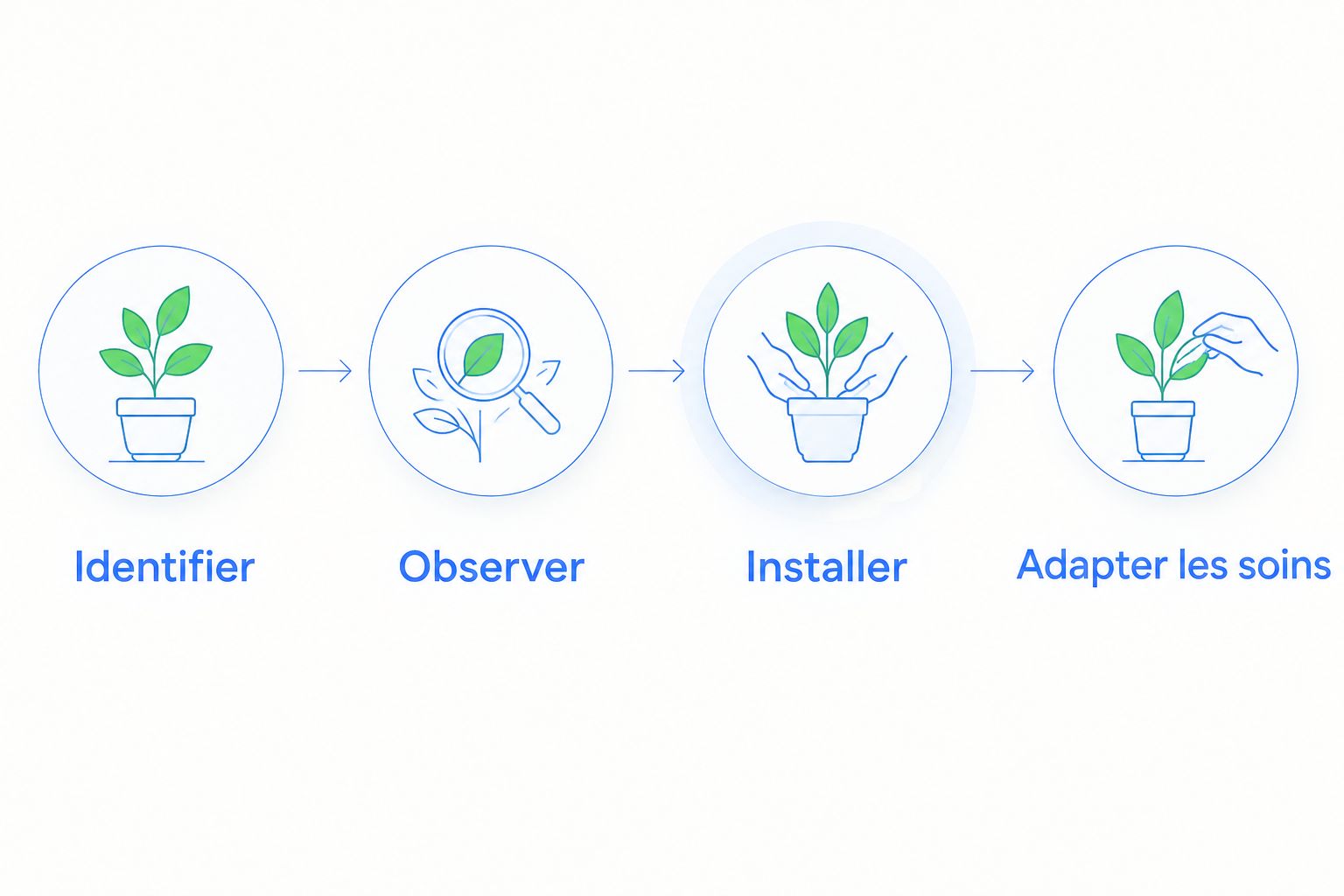
Prepare a bright place before multiplying the containers on a shelf. Then, proceed in this order: identify, observe, set up, then adapt the care. This method avoids reflexively watering or repotting the entire selection.
- Identify. Keep the name of each plant and the instructions that accompany it. A label allows you to find the right advice when the young foliage looks alike.
- Observe. Look at the leaves, the moisture of the medium, and the visible roots without pulling on the stem. A damaged leaf is not enough to conclude that the entire plant is failing.
- Set up. Place each plant in a suitable and stable location. Avoid contact with a cold windowpane, a radiator, or a draft.
- Adapt the care. Decide on watering according to the condition of the soil and the needs of the species. Do not repot solely to change the appearance of the container.
If a cutting is not rooted, follow the method corresponding to its species. Water is not a universal solution: some plants propagate differently or require a particular medium. For a cutting already in soil, avoid digging it up simply to check its roots.
What light to expect in December?
Look for light suited to the species, often bright without burning sun for many indoor tropical plants. A place near a window is generally more useful than a shelf far away in a room that is nevertheless bright.
In December 2026, as during the whole winter, do not compensate for a lack of light with more water. A plant that grows slowly does not use water at the same pace as during full growth. Observe its environment before changing the watering.
How to water without drowning the roots?
Touch the soil and observe its evolution before watering. The frequency depends on the plant, the container, and the conditions of the room: a fixed calendar does not replace this check.
When you water a plant in a perforated pot, let the excess drain out then empty the pot. For cuttings in the process of rooting, apply the instructions specific to their medium. Moist does not mean soaked.
Should you repot immediately?
No, not systematically. Repotting consists of changing the pot or the growing medium; it is not a mandatory step upon opening the gift.
Wait until you have a concrete reason: unsuitable container, problematic soil, or roots that have become cramped. Then choose a pot suited to the roots, without going directly to a large volume of soil that would remain damp for a long time.
How to choose for the person who will receive the gift?
For a Christmas gift in 2026, start from the recipient's daily life. Do they already like to look at the roots of their cuttings? Do they have an unobstructed window? Are they often absent? These answers are more useful than a general preference for rare plants.
- For a motivated beginner: opt for plants identified with accessible needs. The pot format simplifies setup, but also check the selection.
- For a collector: cuttings are interesting if they appreciate propagation. A collector may also prefer young plants to avoid this step.
- For a person who is often absent: do not assume that a plant calendar is suitable. Talk first about the care and the space required.
- For a child with supervision: choose a gift followed by an adult and check the safety of the species. An indoor plant is not necessarily harmless if it is chewed.
Present the care as part of the gift, without downplaying it. A small well-adapted collection brings more pleasure than a set that the person does not want to maintain.
Can you gift cuttings to someone who is starting out?
Yes, if the cuttings and their care match their experience. A rooted cutting of an accessible plant can be a good start; a selection requiring several methods of propagation requires more support.
For a first gift, above all explain how to recognize soil that is too wet and where to place the plants. These steps serve more than a long list of equipment.
Do potted plants require less work?
Potted plants avoid the initial rooting step when they are already established. They nevertheless require monitoring the water, light, and condition of the roots. The gain is in setup, not in an absence of maintenance.
Is a cuttings calendar suitable for a collector?
Yes, if the collector likes to grow new plants. Also check if they appreciate surprises: a person who is looking for a specific variety may prefer to choose their plant rather than discover a selection.
Frequently Asked Questions
Which plant advent calendar to choose for Christmas 2026?
Choose the young potted plants to limit setup handling, or cuttings for someone who likes propagation. The available light and the species matter as much as the format.
What is the difference between a cutting and a baby plant?
A cutting is a plant fragment used to obtain a new plant; a baby plant is a young plant. A cutting may already have roots and be planted in soil.
What does Monjungle's plant Advent calendar contain?
Monjungle's Plant Advent Calendar contains 15 baby plants and 10 accessories. It therefore combines plants and accessories, unlike a format composed of cuttings.
How many cuttings does the plant calendar contain?
The Plant Advent Calendar contains 25 plant cuttings, including 5 rare ones. The number of cuttings does not determine their difficulty level.
Do all cuttings need to go in water?
No, not all cuttings need to go in water. The method depends on the species and the rooting status; a cutting already planted in soil does not need to be transferred to water as a rule.
Should the small plants be watered as soon as they are opened?
Water only if the condition of the soil and the needs of the plant justify it. Check the moisture before adding water and do not let water stagnate in the pot.
Are rare plants necessarily difficult to care for?
No, rarity does not define the difficulty of care. Light, humidity, and watering needs are the criteria to examine for each plant.
One last tip before gifting
Give them a place too, not just plants. Discreetly ask where the recipient would set up their new urban jungle: their answer often helps choose between the formats.
The useful detail is not an additional accessory, but the name kept next to each plant. After the holidays, this simple habit allows you to find the right advice, understand a changing leaf, and avoid applying the same care to the entire collection.
To go further
Share


